
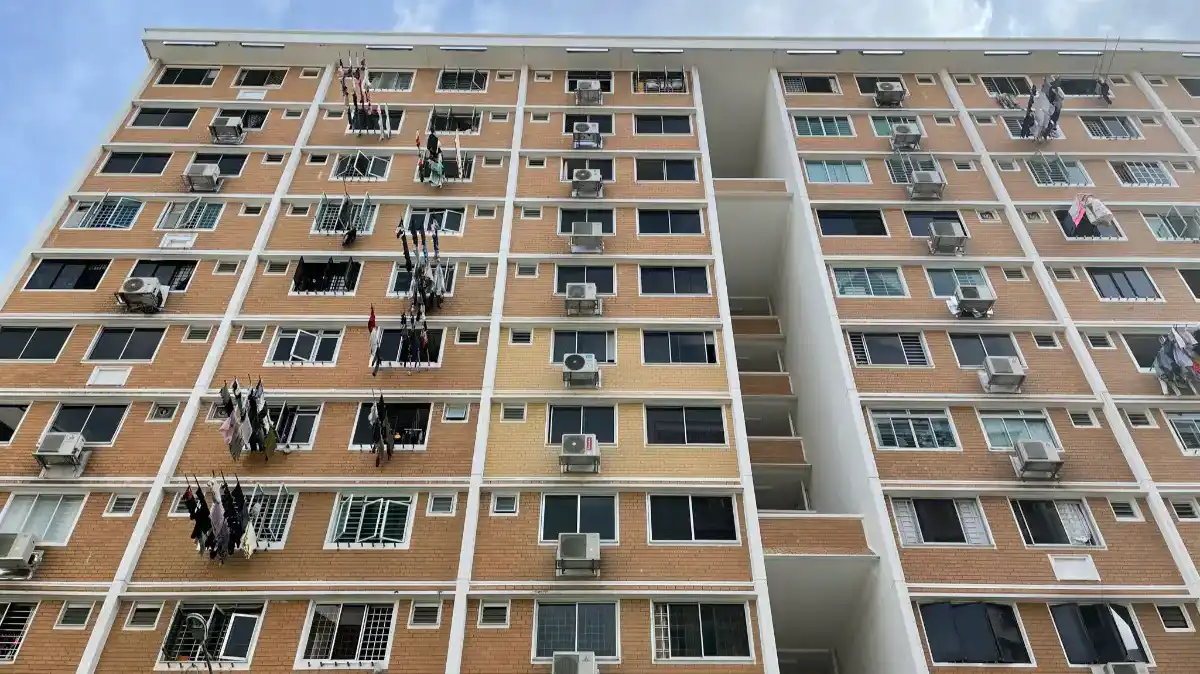

There is a question I get asked more and more these days, usually in a slightly worried voice: “Calin, my flat is quite old already. Is it going to be worth nothing?”
It is a fair question. Singapore’s housing stock is ageing. Flats built in the 1980s are now well past the halfway mark of their 99 years, and a whole generation of leasehold condos from the 1990s is heading the same way. Lease decay has quietly become one of the most important things a homeowner here needs to understand.
But I find that the way it gets discussed is often unhelpful. Either it is doom — your flat will be worth zero! — or it is dismissal — aiyah, don’t worry, government will take care one. Neither is true, and neither helps you make a decision.
So let me try to explain it the way I explain it to clients sitting at my dining table, with the calculator out.
Lease decay is not really about the years. It is about your future buyer.
This is the single most important idea in this whole article, so let me put it plainly.
A 99-year lease does not lose value simply because a year has passed. It loses value because, as the lease gets shorter, fewer and fewer people are allowed to buy it.
That is the mechanism. Not sentiment, not superstition about old buildings. It is CPF rules and bank financing rules, quietly shrinking your pool of future buyers year by year. And a smaller buyer pool eventually means weaker demand, which means pressure on price.
So when you are looking at an ageing property, the question is not “how do I feel about the remaining lease?” The question is: when I want to sell this in ten or fifteen years, who exactly will be able to buy it from me, and what will they be able to pay?
Everything else follows from that.
The two numbers you need to remember: 20 and 95
Here are the CPF rules in their simplest form.
(1) The property needs more than 20 years of remaining lease for CPF savings to be used towards the purchase at all. Below that, CPF is off the table entirely — the buyer must find the whole amount in cash.
(2) If the remaining lease covers the youngest buyer to at least age 95, CPF can be used in full, up to the valuation limit.
(3) If it does not cover the youngest buyer to 95, CPF usage is pro-rated. Still usable, but less of it — and the shorter the lease, the smaller the proportion.
There is a rough mental shortcut that works surprisingly well: buyer’s age + remaining lease should reach about 95. A 30-year-old buyer looking at a property with 65 years left lands exactly on 95, and sits comfortably. That same 30-year-old looking at 50 years left does not, and their CPF gets pro-rated.
Do you see what that means for you as a seller? If your property has 50 years left, you have not just lost lease years. You have lost the buyers who needed full CPF to make the purchase work.
Pro-tip: before you make an offer on any older property — or before you set an asking price on your own — run the numbers through the CPF Board’s housing usage calculator. It takes five minutes and it is free. I do this for clients as a matter of routine, and it has changed more than a few minds, in both directions.
Financing works in a similar way. Loan tenure is capped, and lenders look at how much lease is left when the loan finally ends. Different banks have different internal rules, so this is a conversation to have with a banker before you commit to anything — not after the option is signed.
Why the decline is not a straight line
People assume a 99-year lease loses roughly one ninety-ninth of its value each year. It does not.
Valuers use what is commonly called Bala’s Table to estimate what a leasehold interest is worth compared to a freehold one, and the shape of it is not a straight line. For the first few decades, the erosion is gentle. Then it steepens. The last stretch falls away sharply.
Which makes sense once you understand the mechanism. Early on, nothing much changes for the next buyer — full CPF, normal loan, no obstacles. It is only when the remaining lease starts colliding with those CPF and financing thresholds that the effect becomes visible in the price. The decline follows the restrictions, not the calendar.
The practical implication: the cost of waiting is not constant. Holding an ageing property for five more years when it has 70 years left is a very different decision from holding it for five more years when it has 45 left.
So when should you think about exiting?
I want to be careful here, because I am wary of agents who make sweeping statements designed to create urgency. There is no magic number, and anyone who gives you one without asking about your circumstances is selling you something.
That said, here is how I frame it with clients.
Around 65 years remaining is a comfortable place to be. Your buyer pool is still wide, and most buyers face no real restrictions.
Between 50 and 60 years, things start to tighten. Younger buyers begin getting pro-rated on CPF. It is still very saleable, but you will notice more buyers doing sums before they commit.
Below 50 years, the pool narrows meaningfully. Below 40, it narrows a lot. And under 20 years, you are looking at cash buyers only.
If selling is already somewhere in your plan — not a definite decision, just a possibility on the horizon — then it is worth understanding where your property sits on that curve now, rather than discovering it later. The clients who end up in a difficult position are almost never the ones who decided to hold. They are the ones who never actually decided anything.
And do bear in mind that you may not get to choose your timing. A job posting overseas, an illness in the family, a marriage that ends — life has a way of setting the schedule for you. (I write about the property side of that last one here, because it comes up more often than people think.) An asset that is easy to sell gives you options. An asset that is hard to sell gives you fewer.
If you are buying an older property
Older properties genuinely do offer things newer ones cannot. More space for the money. Established neighbourhoods with real trees. Bigger balconies, wider corridors, layouts that were designed before every square foot had to be monetised. I understand the appeal completely, and I have helped clients buy them happily.
The things I would want you to think through:
(1) Be strict about the entry price. With an ageing property, price discipline matters more than usual, because you have less room to recover from overpaying. Look hard at what comparable units nearby have actually transacted at. If you are being asked to pay well above the recent comparables in the same development or the same street, ask why — and be sceptical of the answer.
(2) Check what is planned around it. A mature estate with a transformation plan attached to it is a different proposition from a mature estate where nothing is scheduled to change. The URA Master Plan is public and free to look at. Spend an evening with it.
(3) Know which buyer you are handing it to. If you buy something with 60 years left and plan to hold for fifteen years, you will be selling a 45-year lease. Picture that buyer honestly. Can they use CPF? Can they get a loan? If the answer is uncomfortable, factor it into what you pay today.
(4) Separate the space question from the investment question. This is the one I find most useful for young families. If what you need is room for three children, that is a lifestyle requirement, and there may be cheaper ways to solve it than buying the biggest ageing unit you can stretch to. Sometimes the better plan is a smaller property chosen for its resale prospects, with the space problem solved another way. I walked through this kind of trade-off with a young couple here: asset progression for a young couple.
There is one clean exception to all of this. If you have found a place you intend to live in for the rest of your life, and resale value is genuinely not part of your plan, then a shorter lease can be an entirely rational purchase — you are buying the years you will actually use, at a discount. Just be honest with yourself that this is what you are doing, and make sure the CPF and financing work at your age.
Using lease decay in a negotiation
Since we are being practical: the restrictions I described above are also a legitimate negotiating position.
You are taking on a real, quantifiable risk — a narrower resale market later. That deserves to show up in the price today. The way I put it to a seller’s agent is not confrontational, just factual: here is the remaining lease, here is what it means for CPF and financing for the buyers who will come after us, and here is the price at which my client is willing to accept that risk.
Reasonable sellers understand this. The ones who do not, usually have not run the numbers themselves.
Can you top up the lease?
This question comes up constantly, so let me be clear about it.
For an individual HDB flat owner, no. There is no counter you can walk up to, pay a fee, and walk away with a fresh 99 years.
For private property on State leasehold land, owners may apply to the Singapore Land Authority for a lease renewal — but approval is not automatic, and it is not a formality. It depends on the Government’s longer-term plans for that land and the views of the relevant agencies. It is a possibility, not a plan.
For older leasehold condominiums, the more realistic route is usually a collective sale, where owners sell the whole development together to a developer who then deals with the lease. This is worth knowing about if you own in an ageing development, particularly given the proposed changes to consent thresholds for older projects — I wrote about those here. But again: a possibility, not a plan. Most developments never go en bloc.
What about SERS and VERS?
I will say this as gently as I can, because I know some owners are quietly counting on it.
SERS — the Selective En bloc Redevelopment Scheme — has been running since 1995, and only a very small proportion of blocks have ever been selected. Selection is driven by redevelopment potential, not by need or by age alone. It is a wonderful outcome for those who get it. It is not a retirement plan.
VERS — the Voluntary Early Redevelopment Scheme — was announced as a future route for ageing precincts, offered somewhere around the 70-year mark, with residents voting on whether to take part. Rollout is expected in the 2030s and the detailed framework has not been finalised. What has been signalled is that compensation would be less generous than SERS, precisely because it is intended to cover a far wider pool of flats. There is no way, today, to calculate the odds for any particular block.
So my honest advice: treat both as upside, not as a plan. Make decisions that work if neither happens. If one does, wonderful.
And if a lease genuinely runs to its end without either? The property returns to the State, with no compensation, and the owner has to have found somewhere else to live before that day. That is the part nobody enjoys saying out loud, but you deserve to hear it plainly rather than discover it at 80.
What about renting it out instead?
Sometimes the plan is: don’t sell, just rent it out and collect income.
That can work, especially in a mature location where tenants want the address and the amenities. But be realistic about the long run. As a building ages, maintenance costs rise — and so do the special levies and repair bills. Tenants compare your unit against newer developments with better facilities, and they negotiate accordingly. Meanwhile, the lease keeps running down in the background.
Rental income can be a good reason to hold for a while. It is a weaker reason to hold for decades.
If you are older, and this is your flat
For seniors in an ageing flat, the picture is different again, and often better than they expect.
HDB’s Lease Buyback Scheme lets eligible owners aged 65 and above sell the tail end of their lease back to HDB while continuing to live in the flat. The proceeds top up the CPF Retirement Account, with a cash bonus depending on flat type. For someone who is asset-rich and cash-tight — which describes a great many older Singaporeans — it converts a decaying asset into monthly income without anyone having to move.
Right-sizing is the other route, and it can work beautifully when it is planned rather than forced. Two client stories that cover this ground: helping a client own an HDB flat after 55 and helping a 55-year-old client upgrade to a condo.
And if the move involves selling private property and buying a resale flat, do note that the 15-month wait-out period has been removed for non-subsidised resale flats bought without an HDB loan — which has made this path considerably easier than it was. More on that here.
One more small but expensive detail: if you buy and then need to sell again sooner than expected, Seller’s Stamp Duty may apply, and the rules were tightened in 2025. Worth checking before you move, not after — I set out the changes here.
What I would actually do
If you own an ageing property and you are not sure what to do, here is the sequence I would suggest.
(1) Find out exactly how many years are left. Not roughly. Exactly. Many owners are two or three years out in their own heads, and near a threshold, that matters.
(2) Work out what a typical buyer could do with it today — CPF usage and loan — and then repeat the exercise for five and ten years from now. This is the single most clarifying thing you can do.
(3) Decide what the property is for. Somewhere to live for good? A source of rental income? A stepping stone to something else? Different answers point to genuinely different decisions, and the mistake is not choosing wrongly — it is never choosing.
(4) Then, and only then, talk about price and timing. In that order. Most people do it backwards.
A closing thought
Lease decay does not make an older home a bad home. I have sat in ageing flats with beautiful light and neighbours who have known each other for thirty years, and thought: I understand entirely why you don’t want to leave.
What lease decay does is make the timing of your decisions matter more. And timing is much easier to manage when you can see it coming — which is really all this article is meant to do.
If you would like someone to sit down and work out where your property actually stands, with the CPF and financing numbers rather than a guess, do get in touch. No pressure to sell, and no assumption that selling is the right answer — sometimes I do the sums and tell people to stay put. You are also welcome to browse my client stories first to see how I work.
Your home has more time left than the internet would have you believe. But it has less time than doing nothing assumes.
Frequently asked questions
What is lease decay? Lease decay is the gradual loss of value as a leasehold property’s remaining lease runs down. The value falls mainly because CPF and financing restrictions shrink the pool of buyers who can purchase it, not simply because years have passed.
When does lease decay start to affect CPF usage? Two numbers matter. The remaining lease must be more than 20 years for CPF to be used at all. And if the remaining lease does not cover the youngest buyer to age 95, CPF usage is pro-rated. Use the CPF housing usage calculator to check your own situation.
How many years of lease should be left when I sell? There is no fixed rule, but around 65 years remaining leaves you with the widest buyer pool. Below 50 years the pool narrows meaningfully, and below 40 it narrows a great deal.
Can I top up the lease on my HDB flat? No. There is no scheme for an individual flat owner to top up a lease. Owners of private property on State leasehold land may apply to SLA for a lease renewal, but approval is not automatic.
Should I count on SERS or VERS? No. Only a very small proportion of HDB blocks have been selected for SERS since 1995, and VERS’s framework has not been finalised, with rollout expected in the 2030s. Treat both as possible upside rather than as a plan.
What happens if the lease actually runs out? The property returns to the State with no compensation, and the owner must have arranged alternative housing before then.
This article is for general information only and reflects the rules as at the time of writing. It is not financial or legal advice. Please check current requirements with CPF Board, HDB and your banker, and speak to a qualified professional about your own circumstances.
